A Rash on the Face, Anogenital Region, and Extremities of a 3-Month-Old Boy - Consultant360
AUTHORS:
Erin Hannon, MD1 • Keri Wallace, MD2
AFFILIATIONS:
1Medical Student, University of Connecticut School of Medicine, Farmington, Connecticut
2Assistant Professor of Pediatrics, University of Connecticut School of Medicine, Farmington, Connecticut
CITATION:
Hannon E, Wallace K. A rash on the face, anogenital region, and extremities of a 3-month-old boy. Consultant. 2022;62(3):e15-e18. doi:10.25270/con.2021.06.00012
Received February 1, 2021. Accepted March 23, 2021. Published online June 25, 2021.
DISCLOSURES:
The authors report no relevant financial relationships.
CORRESPONDENCE:
Erin Hannon, MS, University of Connecticut School of Medicine, 200 Academic Way, Farmington, CT 06032 (erinhannon24@gmail.com) 
A previously healthy 3-month-old boy was brought to the primary care pediatric dermatology clinic by his parents for evaluation of worsening facial, diaper, and extremity rash.
History. The infant was in his usual state of health until 1 month prior to presentation when he began to develop a facial rash, his mother reported. His mother also reported that the initial lesions had been perioral "bumps" that evolved to confluent, erythematous plaques. One week after the perioral rash had appeared, the infant had developed a similar eruption in his diaper region. The patient was seen by his pediatrician at that time, and presumed impetigo was diagnosed and treated. The patient had limited response to topical mupirocin and oral cephalexin.
Upon presentation to our clinic a few weeks later, the patient's mother noted that new lesions had been developing on his upper and lower extremities, in addition to those in the perioral and diaper regions. The infant had recently begun having increased stools, and there was a slowing of his growth curve from the 21st percentile at birth to the 5th percentile at presentation (3 months of age). He was exclusively breast fed, and his mother is a pescatarian.
A review of systems showed no history of fevers, irritability, vomiting, feeding difficulty, hair loss, ocular symptoms, or nail changes. The infant was delivered at full-term after an unremarkable pregnancy. He had been born appropriate for gestational age and had an unremarkable newborn nursery course with no subsequent hospitalizations or surgeries.
He had no known allergies, and his family history was only significant for eczema on his father's side. The patient lived with his parents and 8-year-old brother. 
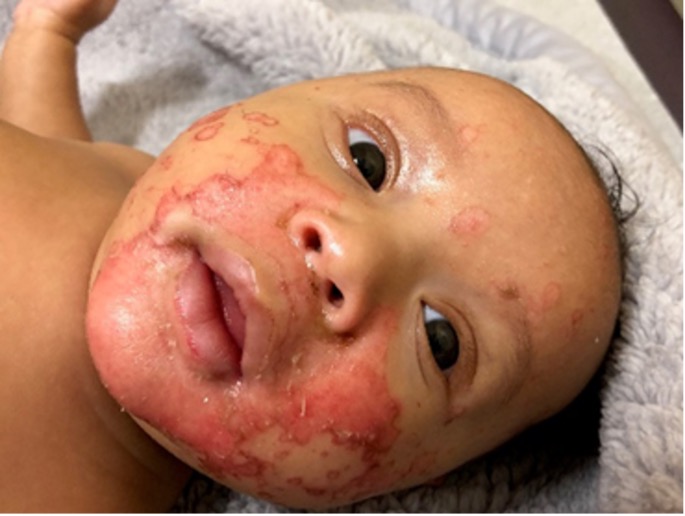
Physical examination. The infant was well-appearing and in no apparent distress. Results of a skin examination were remarkable for erythematous, confluent, sharply demarcated, denuded facial plaques most notable in perioral distribution. There was a small amount of infranasal crusting as well (Figure 1).
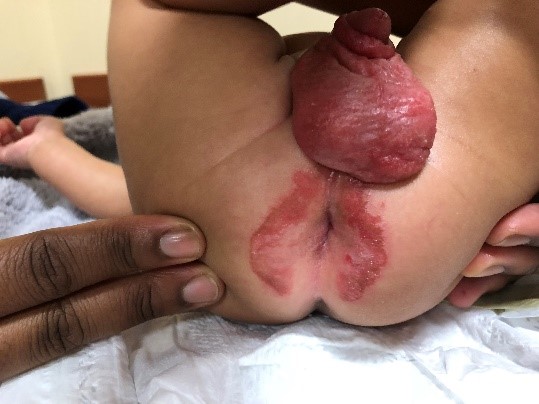
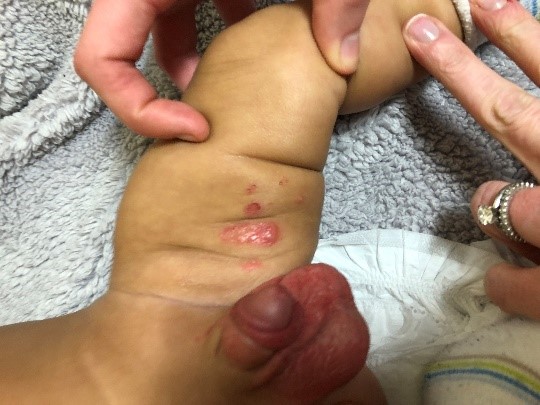
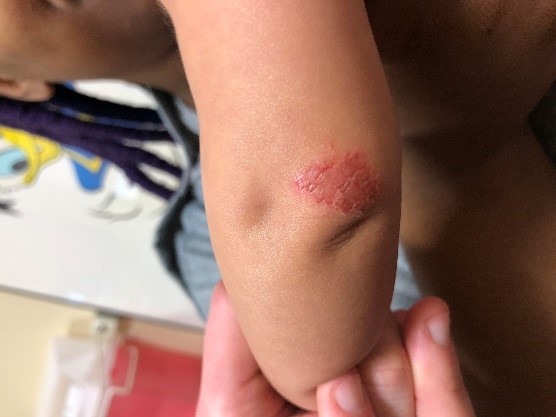
Confluent, erythematous plaques with peripheral prominence were noted in the perianal region, along with mild diffuse erythema in the scrotal region (Figure 2). The inguinal folds were clear, and no xerosis was noted. Smaller, well-demarcated, scaly, erythematous plaques were scattered on the patient's upper and lower extremities (Figures 3 and 4). The rest of the physical examination was unremarkable.
Diagnostic tests. A skin culture of the affected area on the patient's face grew normal skin flora without pathogenic organisms. The patient's serum zinc level was low at 12 μg/dL (reference range, 26-141 μg/dL).
Answer and discussion on next page.
A Rash on the Face, Anogenital Region, and Extremities of a 3-Month-Old Boy - Consultant360


Comments
Post a Comment